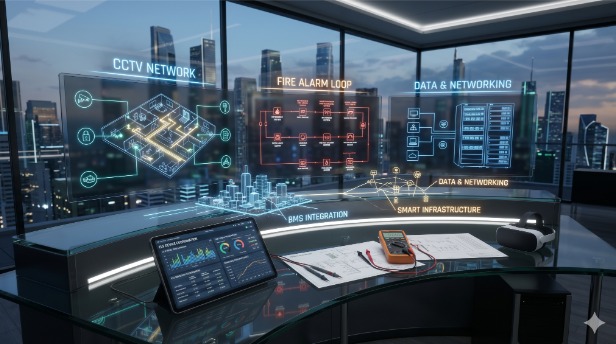
Electrical engineering is no longer limited to cables, calculations, and diagrams. Today’s electrical engineer operates in a world driven by automation, smart infrastructure, renewable energy, digital systems, and rapidly evolving technologies. Modern projects demand engineers who can think beyond theory and confidently handle real technical environments with precision, speed, and professional judgment.
Yet despite this rapid transformation, many training approaches still rely heavily on academic memorization while overlooking one critical factor: practical engineering readiness.
The gap between university learning and actual electrical engineering practice continues to challenge thousands of graduates entering the market every year. Many understand formulas but struggle with:
Real design workflows
Site coordination
Equipment selection
Technical documentation
Load analysis
Protection systems
Project execution realities
This is where modern electrical engineering training must evolve.
True electrical engineering education should simulate real projects, expose learners to actual engineering decisions, and prepare them for the technical pressure of the professional environment.
Our philosophy is based on transforming electrical engineering education into a practical, immersive, and industry-oriented experience that develops engineers capable of designing, analyzing, troubleshooting, and delivering electrical systems with confidence.
1. Practical Learning Beyond Theory
Electrical systems cannot be mastered through slides and lectures alone.
An engineer truly learns when calculations become systems, diagrams become installations, and technical decisions produce measurable results.
That is why our training model focuses heavily on implementation-based learning.
Real Engineering Interaction
Instead of passive instruction, learners engage in:
Live engineering exercises
Design simulations
Electrical troubleshooting scenarios
Technical discussions
System analysis workshops
This creates an active learning environment where engineers develop critical thinking and technical confidence simultaneously.
Learn by Building
Every lesson transitions directly into practical implementation.
Learners apply concepts through:
Electrical load calculations
Single-line diagrams
Panel schedules
Cable sizing
Voltage drop analysis
Protection coordination
Equipment selection
This immediate application reinforces understanding and mirrors actual engineering workflows.
2. Training Through Real Electrical Projects
Electrical engineering becomes truly valuable when connected to actual projects and field conditions.
Real projects contain complexities rarely found in textbooks:
Coordination conflicts
Space limitations
Budget restrictions
Safety requirements
Site modifications
Client demands
Technical compromises
Our learning experience exposes engineers to these realities from the beginning.
Real Drawings & Technical Documents
Learners work with authentic engineering materials including:
Electrical layouts
Shop drawings
Panel board schedules
Load distribution systems
Lighting calculations
Technical specifications
Equipment datasheets
This practical exposure builds familiarity with professional engineering documentation and standards.
Learning from Experienced Engineers
One of the most powerful forms of learning is direct mentorship from engineers who have worked on real projects.
Our mentors share:
Technical insights
Site experience
Common engineering mistakes
Design optimization methods
Execution strategies
Professional coordination techniques
This practical transfer of knowledge accelerates professional growth far beyond traditional education.
3. Structured Engineering Workflow
Electrical engineering projects follow logical sequences and interconnected systems.
Training should reflect the same structure.
Our educational approach organizes learning into progressive engineering stages that simulate actual project development.
Phase 1 — Core Fundamentals
Engineers begin with foundational technical tasks such as:
Understanding electrical principles
Reading electrical symbols
Basic circuit analysis
Preliminary calculations
Understanding standards and safety practices
This stage builds technical confidence and engineering clarity.
Phase 2 — System Integration
After mastering fundamentals, learners progress into integrated electrical systems involving:
Power distribution
Lighting systems
Low-current coordination
Load balancing
Protection systems
Equipment selection
At this level, engineers begin understanding how entire systems interact within real buildings and facilities.
Phase 3 — Full Project Development
The final stage focuses on complete electrical project simulation.
Learners participate in:
Full system design
Technical review processes
Design revisions
Coordination meetings
Compliance verification
Final project submission
This stage mirrors the workflow used in consulting offices, contractors, and engineering firms.
4. Electrical Codes, Standards & Safety Compliance
Electrical engineering is one of the most regulation-driven engineering disciplines in the world.
Design decisions directly impact:
Human safety
Equipment reliability
Energy efficiency
Fire protection
Operational continuity
Therefore, engineers must understand not only system design — but also the standards governing these systems.
Code-Oriented Training
Learners are trained using real international and regional standards including:
NEC
IEC
IEEE
NFPA
SBC
Egyptian Electrical Codes
This prepares engineers to work confidently across different regional markets and project environments.
Safety-Centered Engineering
Electrical safety is integrated into every stage of training.
Learners understand:
Short-circuit protection
Grounding systems
Arc fault risks
Equipment protection
Electrical hazards
Safe installation practices
This develops engineers who prioritize both technical performance and operational safety.
5. Training for Every Career Stage
Electrical engineering professionals grow through multiple career phases, and each stage requires different technical depth and responsibilities.
Our learning structure supports engineers from beginner level all the way to advanced professional specialization.
Beginner Level
Objective
Build strong technical foundations and software familiarity.
Focus Areas
Electrical basics
Circuit fundamentals
Drawing interpretation
Introductory calculations
Software introduction
Understanding electrical systems
Learning Style
Step-by-step guided tasks with continuous support and technical explanation.
Intermediate Level
Objective
Develop professional design and coordination capabilities.
Focus Areas
System integration
Technical calculations
Distribution systems
Protection coordination
Design review
Site-related challenges
Learning Style
Practical projects requiring engineering judgment and problem-solving.
Expert Level
Objective
Master advanced electrical engineering analysis and leadership.
Focus Areas
Advanced power systems
Energy optimization
Industrial systems
Smart infrastructure
Value engineering
Technical management
Large-scale project coordination
Learning Style
Complex project scenarios, advanced reviews, and strategic technical decision-making.
The Future of Electrical Engineering Starts with Practical Experience
Modern electrical engineers are expected to do far more than perform calculations.
They must:
Analyze systems critically
Solve technical problems efficiently
Communicate professionally
Coordinate with multidisciplinary teams
Adapt to evolving technologies
Deliver reliable and safe solutions under real project conditions
Engineering education must therefore evolve into a practical ecosystem where learning, implementation, analysis, and professional development happen together.
The goal is no longer simply to teach electrical engineering.
The goal is to develop engineers who are fully prepared to perform, innovate, and lead in the modern engineering industry.
Comments (0)

Categories
Recent posts

Preparing Engineers to Design Efficient, ...
30 May 2026
How to Shape Job-Ready Engineers for the ...
30 May 2026
Building Engineers Who Can Design, ...
30 May 2026