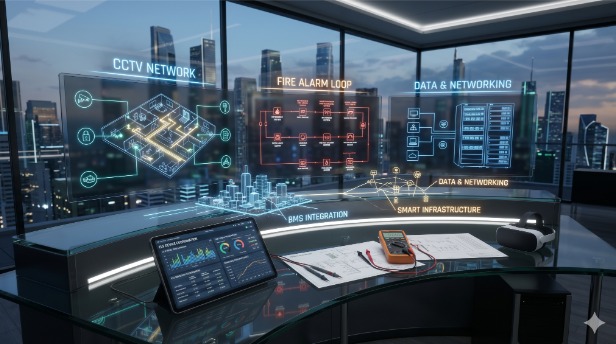
Extra Low Voltage (ELV) systems have become one of the most critical components of modern buildings and smart infrastructure. From security and surveillance systems to fire alarm networks, data communication, access control, automation, and intelligent building technologies — ELV engineering now sits at the center of how modern facilities operate efficiently, safely, and intelligently.
As cities become smarter and projects become more technologically integrated, the demand for highly skilled ELV engineers continues to grow rapidly across residential, commercial, industrial, healthcare, and infrastructure sectors.
However, one major challenge still exists:
Many engineers graduate with limited exposure to the practical implementation of ELV systems in real projects.
Understanding theory alone is no longer enough.
Modern ELV engineers must understand:
System integration
Real installation workflows
Device coordination
Network communication
Technical standards
Site execution requirements
Troubleshooting and commissioning processes
This is why modern ELV training must go far beyond traditional teaching methods.
Our educational philosophy is built around creating practical, industry-ready ELV engineers who can confidently design, coordinate, implement, and manage integrated low-current systems in real-world environments.
1. Practical & Interactive ELV Learning
ELV systems are highly application-oriented.
The true understanding of these systems comes through implementation, testing, coordination, and problem-solving.
That is why our training approach focuses heavily on interactive and hands-on technical learning.
Learning Through Real Interaction
Instead of relying solely on theoretical explanation, learners actively engage in:
ELV system simulations
Technical workshops
Real-case troubleshooting
Device configuration exercises
Coordination scenarios
Smart building integration discussions
This creates an engineering-focused learning environment that mirrors real technical operations.
Immediate Technical Application
Every concept is connected directly to implementation.
Learners apply knowledge through:
System layouts
Device selection
Cable routing
Network topology planning
Configuration exercises
Integration workflows
Technical documentation preparation
This direct application helps engineers understand not only how systems work — but also how they are executed professionally.
2. Training on Real ELV Projects
Modern ELV projects involve far more than connecting devices.
Real projects include:
Multi-system integration
Architectural coordination
Space constraints
Communication protocols
Client requirements
Security standards
Site modifications and troubleshooting
These challenges can only be understood through practical project exposure.
Exposure to Real Engineering Documents
Learners work with authentic project materials including:
ELV layouts
Shop drawings
Riser diagrams
Network architecture diagrams
Device schedules
Technical specifications
Integration documentation
This prepares engineers for the documentation standards used in real engineering companies and project sites.
Mentorship from Industry Professionals
Our training includes guidance from experienced ELV engineers who have worked on complex projects and intelligent building systems.
Mentors share:
Real site experience
Coordination strategies
Technical problem-solving methods
Installation best practices
System integration approaches
Common field mistakes and how to avoid them
This practical mentorship significantly accelerates technical and professional growth.
3. Structured Learning Workflow
ELV systems are interconnected by nature.
Understanding individual devices alone is not enough — engineers must understand how complete systems interact together.
Our learning model therefore follows a progressive workflow structure similar to actual project execution.
Phase 1 — Core ELV Fundamentals
Learners begin with:
Understanding ELV system categories
Reading technical drawings
Understanding devices and components
Learning communication basics
Identifying system functions and applications
This stage creates strong technical foundations.
Phase 2 — System Coordination & Integration
After mastering the basics, learners move into integrated system workflows involving:
CCTV systems
Fire alarm systems
Access control
Public address systems
Data and networking systems
Smart automation systems
At this stage, engineers understand how multiple systems communicate and operate together within real buildings.
Phase 3 — Full Project Simulation
The final stage focuses on complete ELV project implementation.
Learners participate in:
System design workflows
Device coordination
Technical reviews
Integration planning
Site-oriented problem solving
Testing and commissioning simulations
This phase mirrors real engineering office and site operations.
4. Standards, Codes & Smart Technology Integration
ELV engineering is highly dependent on technical standards, communication protocols, and international safety regulations.
A professional ELV engineer must understand both technical performance and regulatory compliance.
Standards-Oriented Training
Learners are exposed to widely adopted international standards and practices including:
NFPA
IEC Standards
BICSI Guidelines
Security and surveillance standards
Structured cabling standards
Smart building integration principles
This prepares engineers for local and international project environments.
Smart Building & Future Technologies
Modern ELV engineering is rapidly evolving toward intelligent infrastructure.
Learners are introduced to:
Smart building systems
IoT integration
AI-assisted monitoring systems
Intelligent automation
Building Management Systems (BMS)
Future-ready communication technologies
This ensures engineers remain aligned with the future of the industry.
5. Designed for Every Professional Level
Our ELV training pathways are structured to support engineers at every stage of their career journey.
Beginner Level
Objective
Build strong technical understanding of ELV systems and components.
Focus Areas
ELV fundamentals
System identification
Device functions
Basic networking concepts
Technical drawings
Introduction to smart systems
Learning Style
Highly guided implementation and simplified practical tasks.
Intermediate Level
Objective
Develop integration and project coordination capabilities.
Focus Areas
Multi-system coordination
Design workflows
Technical troubleshooting
Integration logic
Communication protocols
Real project documentation
Learning Style
Project-based learning with realistic technical scenarios.
Expert Level
Objective
Master advanced ELV design, integration, and intelligent infrastructure systems.
Focus Areas
Large-scale system integration
Smart city technologies
Advanced security infrastructure
Intelligent automation
Technical management
Complex troubleshooting and optimization
Learning Style
Advanced engineering reviews, strategic planning, and high-level project simulation.
The Future of ELV Engineering Is Intelligent, Integrated, and Practical
The next generation of ELV engineers must be capable of:
Integrating multiple technologies
Solving real operational problems
Managing intelligent systems
Understanding smart infrastructure
Coordinating across disciplines
Delivering reliable and scalable solutions
Modern ELV education must therefore evolve into a practical engineering ecosystem that combines technical depth, implementation experience, and future technology awareness.
The objective is not simply to teach systems.
The objective is to build engineers who can confidently design, integrate, and lead the intelligent infrastructure of tomorrow.
Comments (0)

Categories
Recent posts


Preparing Engineers to Design Efficient, ...
30 May 2026
How to Shape Job-Ready Engineers for the ...
30 May 2026
Building Engineers Who Can Design, ...
30 May 2026